


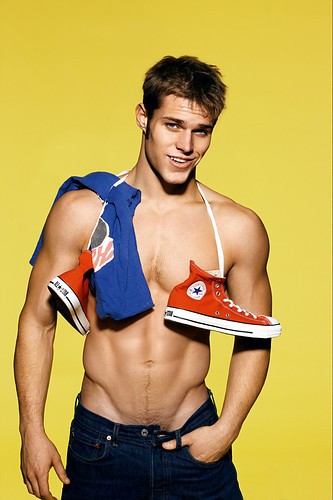
While many of us target leaner builds like that of the twunk (part twink, part hunk) above, how much do you really know about body fat?
When it comes to exercise and nutrition, they’re tons of myths out there. Like that the shake weight actually does anything. Since we hear many of these fallacies so often, we don’t always question their legitimacy.
Today, let’s bust the top 6 myths about body fat:
- Muscle turns to fat. Because many people gain weight when they stop exercising, there’s a misconception that muscle turns into fat. In reality, muscle fibers and fat cells are two very different things; one cannot become the other. The truth: Many people gain weight after they stop exercising because their body is burning fewer calories - but they continue to eat the same amount of food.
- Fat on the body come from fat in foods. This belief has led to a slew of fat-free and reduced fat foods. The truth: Body fat comes from calories, not necessarily fat. If you eat more calories than your body burns - whether it comes from lettuce or a double-cheeseburger - your body will store the extra calories as fat.
- The lower the body fat percentage, the better. To lean down and increase muscle definition, many dieters aim for the lowest body fat percentages possible. The truth: Your body needs some levels of essential body fat to protect organs and facilitate functions. For women, a body fat percentage of 10% - 13% is essential; for men, 2% to 5% is essential. Aim for body fat percentages above these ranges.
- You can target where you want to lose body fat. When we build our muscles, we exercise the muscles we want to grow. For example, doing bicep curls will give you larger biceps. It only seems logical to assume that body fat works the same way. The truth: You can’t spot-reduce body fat. It comes off various body parts according to its own agenda. This may include your face, neck, chest, arms and anywhere else. For men, the pesky beer belly is usually the last to shrink.
- Fat weighs less than muscle. You’ve heard it a million times before. The truth: A pound is a pound; a pound of feathers weighs the same as a pound of bricks. In the same way, a pound of fat weighs the same as a pound of muscle. It’s truer to say that muscle is more dense than fat. And this explains why exercisers may lose inches but not pounds - as they are shedding body fat but also building muscle.
- Starving yourself reduces body fat. Since our body fat comes from calories, it seems to make sense that if we starve ourselves, we’ll lose our extra body fat. The truth: While you will initially lose body fat if you stop eating, your body will go into starvation mood - and your metabolism will come to a grinding halt. Eventually, you’ll need to eat again. And when you do, you’ll gain all the weight back - and then some.
Did these 6 myths change the way you think about body fat? Let me know in the comments below!
 About Davey Wavey

UGH! I just cant figure out the balance to eat the right amount to keep my metabolism up and not gain weight by eating those calories. Its the consistency, I guesss…..No I know it is the consistency. Just cant keep my schedule regular. Grrr!
For me, when I wanted to lose weight, starve myself seems to be the best way around(simply drive myself busier until i forgot to eat). It’s simple for me and it’s true that i’m muscle-less and i always wanted to build some muscle.. is there any lazy way to gain muscles?? xD
There is no “lazy” way to gain muscle. By definition, a muscle or muscle group must be worked in order to stimulate growth. It’s your muscle, your body, your work to do. If it were easy, were there a lazy way to go about it, obesity wouldn’t be in epidemic in the U.S.
Yet still they persist 🙁 It’s a worry, especially among young (mainly gay) men, I find. Fad diets, pills, wonder food, hearsay, nutritional advice from gossip mag journalists. Sensible, nutritional balanced diet and moderate/good exercise just isn’t sexy enough!
When you’re 16-20, you have no interest (or concept of!) even living to over 40, let alone being as fit and healthy when you get there.
Very, very useful information!!! 🙂 I agree!
I didn’t know the fifth! Thanks!
Tomorrow I’ll see Britney in Zagreb, yesss! :’)
I actually knew all these but think many are not. These were all good myths to bust. The boy in the picture….where do you consistently come up with these beauties?
That picture is a friend of mine from college. He’s straight too lol
very useful information..thanks a lot!!
boy-thanx for this invaluable info.i had some idea-thanx for elaborating.i will reread this blog entry.i so much need to digest this info-and react to it later today.truly the bells and whistles went off in my head-loud and clear.